|
| ...The painter prince discovered the place
in 1892, when he rented a house there for a few days. Seven
years later he bought the premises and had a new house designed
and erected. |
|
| The Galllery at Waldarmarsudde |
 |
| Prince Eugen had been educated as a painter
in Paris and after his death the house was converted to a museum
of his own and other paintings. The prince died in 1947 and
is buried by the beach close to the house. |
| |
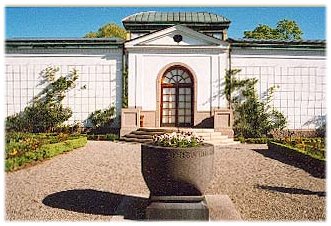
The complex consists of a castle-like main
building - the Mansion - finished in 1905 and designed by
the Swedish architect Ferdinand Boberg, and a Gallery Building,
added in 1913. The estate also includes the original manor-house
building, known as the Old House and an old linseed mill,
both dating back to the 1780s. The estate is set in beautiful
parkland, featuring centuries-old oak trees. Its situation
by the inlet to Stockholm harbour presents the visitor with
stunning views of the water. |
| |
|
|
|
| Skansen |
| |
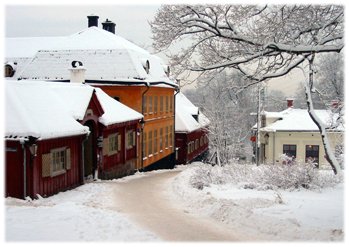 |
| Winter at Skansen |
|
| |
| Skansen is an open air museum and zoo located
on the island Djurgården in Stockholm, Sweden. It was
founded in 1891 by Artur Hazelius (1833-1901) to show the way
of life in the different parts of Sweden throughout history,
and is generally considered the oldest continuously running
open-air museum in the world. |
| |
| The 19th century was a period of great change
throughout Europe and Sweden was no exception. Its rural way
of life was rapidly giving way to an industrialized society
and many feared that the country's many traditional customs
and occupations may be lost to history. |
| |
| Artur Hazelius, who had previously founded the
Nordic Museum on the island of Djurgården near the centre
of Stockholm, was inspired by the open-air museum founded by
King Oscar II in Kristiania in 1881 when he created his open-air
museum on the hill that dominates the island. |
| |
|
|
|




 Skansen
was originally a part of the Nordic Museum, but became an
independent organization in 1963. The objects in the Skansen
buildings are still the property of the Nordic Museum.
Skansen
was originally a part of the Nordic Museum, but became an
independent organization in 1963. The objects in the Skansen
buildings are still the property of the Nordic Museum.

